You Don't Need One Big Yes. You Need the Right Stack.

The structure I promised you last time — and why almost nothing of size is funded by a single lender.

Most people picture funding as a single moment. One application, one lender, one answer. You ask for the whole amount, and somebody either says yes to all of it or no to all of it.
That's how smaller borrowing usually works, so it's a reasonable picture. But it isn't how larger deals are put together, and holding onto it causes a very specific kind of disappointment. I've watched owners walk away from projects that were entirely fundable, simply because no single source would cover the whole thing.
Almost nothing of size is funded by one yes. It's funded by several, arranged in a deliberate order. That arrangement is called a capital stack, and it's what I promised to walk you through in my last letter.
One project, several seats at the table
Think of the money behind a deal as a line of people waiting to be paid back.
Whoever stands first in line takes the least risk. If something goes wrong, they're repaid before anyone else, so they can afford to charge the least. That's the senior position — usually the largest piece, usually the least expensive, and usually the most demanding about your file.
Behind them there can be one or more additional layers. Subordinate financing that covers part of what the senior lender won't. Sometimes a seller who agrees to carry a portion of the price. Sometimes a partner who contributes capital in exchange for a share of the outcome.
Each of these stands further back in line, which means each takes more risk, which means each costs more.
And at the very back is you. Your own capital — the down payment, the injection, the money you put in yourself. It's repaid last and it absorbs the first loss, and that is exactly why every layer in front of it wants to see it there. Your money in the deal is the clearest signal anyone has that you believe in it.
Why one lender rarely does it all
Every lender has a lane. A senior lender is comfortable covering a certain portion of a deal's value or cash flow, and not past it — not because they doubt you, but because that's the risk they're built to hold. Asking them to stretch further isn't a negotiation. It's asking them to be a different kind of lender.
So the space between what the senior position will cover and what you bring yourself isn't a dead end. It's a design problem. That space is precisely what the other layers exist to fill.
This is where I see good owners stop too early. They hear "we can do this much" and take it as a no, when it's actually the first layer of a structure that simply hasn't been built yet.
The math that makes it work
People resist adding a more expensive layer, and I understand why. Nobody wants to pay more than they have to.
But the cost that matters isn't the price of the most expensive piece. It's the blended cost of the whole stack — every layer weighted by its size. A smaller, costlier slice in the middle can be the thing that turns a project that doesn't happen into one that does, while the overall cost of the money stays well inside what the deal can carry.
I won't put rates on this here; they move constantly and they depend on the asset, the structure, and the file. The principle doesn't move: you judge the stack as a whole, against what the project produces. A layer is worth paying for when the deal it unlocks is worth more than the layer costs.
A stack is designed. A pile is not.
If you read my letter on sequence, this will sound familiar — and it should.
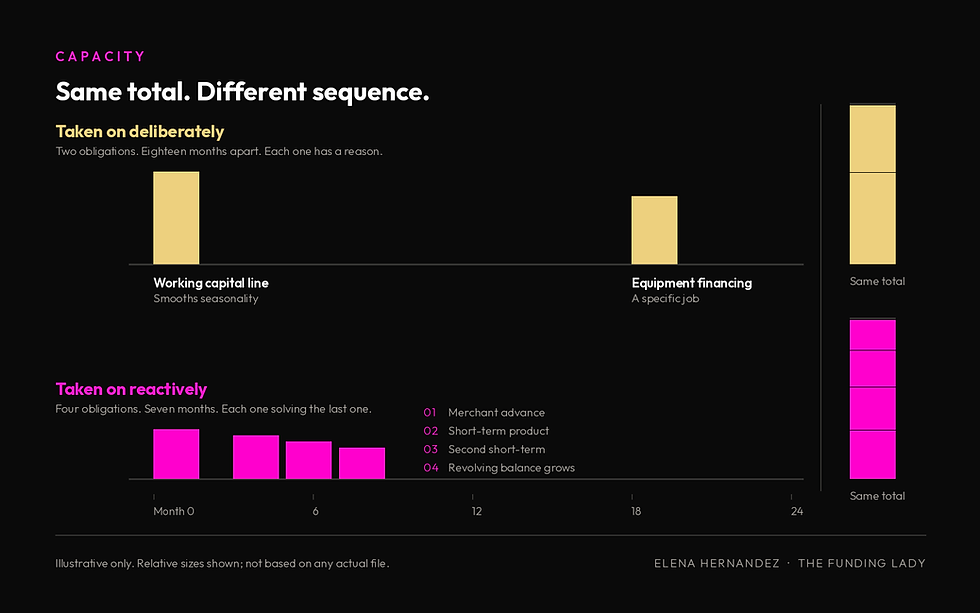
A business that took on four short-term products in seven months to cover each month's shortfall is, technically, carrying layered financing. But nobody designed it. Each piece arrived under pressure, each one competing with the others for the same cash flow, and none of them was built with the others in mind.
That's a pile. A stack is the opposite. Every layer is chosen for a purpose, sized to fit, placed in a known order, and agreed to by everyone in it — including who gets paid first and what happens if things get tight. None of it is left to chance; it's written down before the money moves.
The same total can be either one. The difference is whether someone sat down and built it.
Every layer reads your file
Here's the part that ties this whole series together. Each layer in a stack does its own reading. The senior lender looks closest, but the subordinate lender looks too, and so does any partner putting capital in.
Which means the four things we've been building — structure, rhythm, capacity, and how fast you can produce your paperwork — don't get checked once. They get checked at every seat at the table.
That's good news, not a burden. A clean file doesn't just earn one yes. It opens the door to more kinds of capital, on better terms, in a better order. And when there's an asset in the picture, the stack has even more to work with, because each layer can be anchored to something real.
Where to start
If there's a project you've set aside because the number felt too big for any one source, here's how I'd approach it.
Name the whole number. Not what you think a lender will give you — what the project actually costs, start to finish.
Know what you bring. Your own capital, any assets, and your file. That defines the back of the line.
Settle the senior position first. It sets the shape of everything else, so it's the first conversation, not the last.
Then design the space in between. Look at what's left and decide, deliberately, what belongs there.
This is the work I enjoy most, because it's where projects people had quietly given up on start to look possible again.
Bigger is possible. It just rarely arrives as one yes. It arrives as several, in the right order.
Elena Hernandez — The Funding Lady
📞 +1 (818) 669-3356
This article is educational in nature and does not constitute financial, legal, tax, investment, or credit advice, and is not an offer or commitment to extend credit. Individual circumstances vary and outcomes are not guaranteed. Examples are illustrative only.


Comments