It's Not How Much You're Carrying. It's the Order You Took It On.

Updated: Aug 17
The third of the four things a lender reads — and the one people argue with me about most.
There's a conversation I have more than any other, and it always starts the same way.
Someone tells me they're carrying too much debt. They say it the way you'd confess something. They've added up the balances, they've looked at the total, and they've decided that number is the reason they're not going to get funded. So they've stopped asking. They're waiting until the number gets smaller.
I understand the instinct. But in most of those conversations, the number was never the problem.
I've watched businesses with real obligations on the books get taken seriously. I've watched businesses with almost nothing outstanding get turned away. If the size of the debt were the deciding factor, that wouldn't happen. Something else is being read.
That something is capacity. And capacity is not what you owe. It's what your cash flow still has room for after you owe it — and whether the way you took it on suggests someone with a plan, or someone reacting.
What capacity actually measures
Strip away the vocabulary and a lender is asking one question: if we add this new obligation, does the money still work?
That's it. They look at what comes in, they subtract what's already committed, and they look at what's left. The room that remains is your capacity. A new payment has to fit inside that room with margin to spare, because no one is interested in a deal that only works if nothing goes wrong.
Which means two businesses with identical revenue and identical total debt can be read completely differently. One has obligations that leave breathing room. The other is running so close to the line that a slow month becomes a missed payment. Same balance sheet total. Different answer.
This is why "pay everything down first" is often the wrong strategy. Debt that fits inside your capacity isn't a liability in a lender's eyes — it's evidence. It shows someone extended credit to you before and you handled it. Eliminating it entirely can leave you with a thinner file than the one you started with.
The part nobody explains: sequence
Here's where I lose people, and then eventually win them back.
Capacity isn't only about the math. It's about the story the math tells.
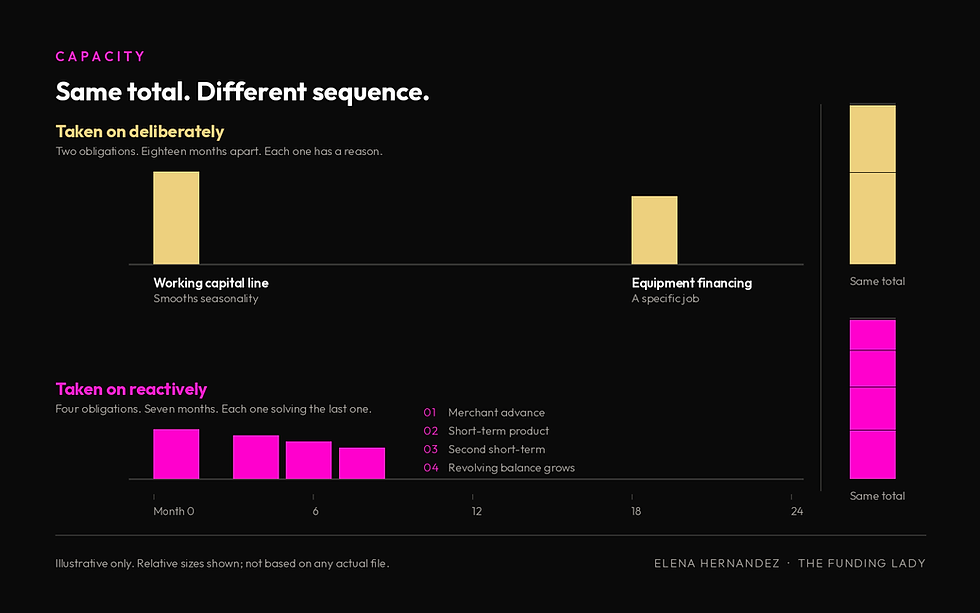
Picture two businesses. These figures are illustrative — they're here to show the shape of the thing, not to describe any real file.
Both are carrying roughly the same total. The first took on a working capital line eighteen months ago to smooth out seasonality, then added equipment financing when a specific machine made a specific job possible. Two obligations. Each one has a reason. Each one arrived when the business was ready for it.
The second has four smaller balances, taken on across seven months, from four different sources. A merchant advance in March. A short-term product in May because the advance made the summer tight. Another one in July. A card balance that grew because the payments were stacking.
Same total. But the second file doesn't read as financing. It reads as a business solving each month's problem with next month's money.
A lender doesn't need to be told which is which. It's visible. The order, the spacing, the type of product, the direction things are moving — all of it is right there in the statements, and it answers a question they care about more than the balance: is this person choosing, or reacting?
Why reactive borrowing is so hard to unwind
The cruelty of it is that reactive borrowing feels responsible while you're doing it. You're covering payroll. You're keeping a commitment. You're not being reckless — you're being loyal to your business.
But each of those decisions makes the next one more expensive. Short-term money taken under pressure comes with terms that compress your capacity further, which makes the following month tighter, which makes the following decision more urgent. The products get faster and costlier as the room gets smaller.
And then, eventually, someone applies for the thing they actually needed all along — the real line, the real structure, the money that would have solved it — and by then the file has been arguing against them for months.
I don't say this to make anyone feel worse about decisions already made. I say it because the pattern is reversible, and almost nobody realizes that.
What to do about it
If you recognize your own file in the second example, here's where I'd start.
Map what you actually have. Not the balances — the terms. What's the payment, what's the frequency, what's the real cost, when does it end. Most people I talk to have never seen all of it on one page. You cannot manage a sequence you can't see.
Find what's compressing you fastest. Usually one or two obligations are doing most of the damage, and they're rarely the largest ones. Daily or weekly repayment products consume capacity out of proportion to their size because they hit cash flow constantly rather than monthly.
Restructure before you add. The instinct is to solve a tight month by adding another obligation. The better move is almost always to change the shape of what's already there first — because adding to a compressed file makes the next conversation harder, not easier.
Then let it settle. This is the part people don't want to hear. After the sequence improves, the statements need time to show it. A few months of the new pattern does more for your file than any single application.
Take the next one on deliberately. When you do add, be able to answer why this, why now, why this amount. Not because anyone will interview you about it, but because a file where every obligation has a reason looks entirely different from one where they accumulated.
Where this sits
If you've been following along: structure came first — the business existing as its own entity, with its own accounts, separate from you. Then rhythm — the consistency across the statements that shows the revenue is real and repeating.
Capacity is the third. It's the one that determines whether there's room for what you're asking for.
There's a fourth, and it's the simplest of all of them, which is why so many people lose on it. I'll get to that one next.
For now, I'd rather you take one thing from this: the total you've been apologizing for may not be what's standing in your way. Before you decide you're not fundable, find out what's actually being read.
That's usually a shorter conversation than people expect.
Elena Hernandez — The Funding Lady
This article is educational in nature and does not constitute financial, legal, tax, or investment advice. Individual circumstances vary, and no particular outcome is guaranteed. Figures referenced are illustrative only.


Comments